
Shared credit
“Not I, but we” — his own words on leadership. Announcements of success consistently name the team and colleagues, not himself.
Born in Dhaka. A Japanese government scholarship in 2000; Japanese citizenship in 2009. The ability to read two states at once — their languages, their administrations, their expectations — is the single qualification on which two decades of work rest.
Quick facts
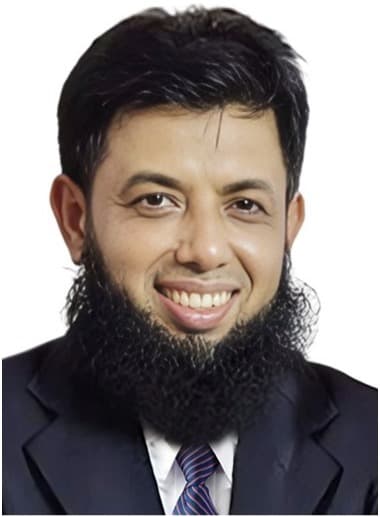
Nagamatsu Faruk's work has a single centre: the passage of students and skilled workers from Bangladesh to Japan — still, to a large degree, a matter of individual luck and the intermediary's will — brought under rules, safety and institutions. He pursues it from two directions at once: direct services through his company, policy-level dialogue through the association he leads; the experience of one supplies the argument of the other. Born in Dhaka, he studied at Tejgaon College before coming to Japan in 2000 on a government scholarship to Ritsumeikan Asia Pacific University, one of Japan's most international campuses. The ability to read both societies at once — their languages, administrative habits and expectations — became the principal asset of his later work; and he spends that asset on one task only: showing two states the same numbers.
Not a character sketch but a record of conduct — beside each trait, where it was seen.
“Not I, but we” — his own words on leadership. Announcements of success consistently name the team and colleagues, not himself.
Bad news is delivered by him as readily as good, with its cause. When five of seven applicants at one Tokyo school were refused, he published the figure himself and set out the route to reapply next semester — an account, not a reassurance.
His one answer to criticism: no person, institution or system is without fault — and counting faults alone is not a policy.
Congratulating students by name, receiving them at the airport, honouring achievers to inspire the next.
Convening committees, annual reports, written invitations, announced sponsors — every event bound into an institutional process, so that the organisation runs without depending on any one person.
Every announcement of an achievement opens with thanks — to the Embassy, colleagues, students and parents.
Warning students against fraud, public alerts about applying through unauthorised channels, and a call to Japan-bound agencies for standards — ‘ethical migration’ is a constant thread in what he says.
I am Nagamatsu Faruk. I first came to Japan in 2000 on a Japanese government scholarship for higher education. While at university I realised that Japan could be a country of great promise for Bangladeshi students, and since 2002 I have worked continuously in student consultancy. Today I serve as Chairman of Rijik International Co., Ltd. Drawing on that experience, and together with experienced consultants based in Japan, we formally founded the Bangladeshi Students' Support Association in Japan (BSSAJ) on 26 April 2025. I have served as its President since its founding.
BSSAJ exists to equip students and workers from Bangladesh — before they arrive — with the language, cultural understanding, knowledge of rules and conduct they need to establish themselves successfully in Japan's modern, disciplined society. Alongside that, we support those already in Japan's labour market with whatever problems they face, and we encourage Japanese language schools, universities and companies to welcome more students and skilled workers from Bangladesh.
I am especially grateful to H.E. Md. Daud Ali, Ambassador of Bangladesh to Japan. In coordination with the Embassy we hold regular policy dialogues, education discussions, university visits and human-resource development programmes that are opening new opportunities for students.
Within the next two to three years we plan to establish a BSSAJ Tower in Bangladesh: a modern research centre for language education, Japanese culture, skilled-workforce development and research. Through it we will extend training and human-resource development across the whole of Bangladesh.
— Nagamatsu Faruk, President, BSSAJ
For organisers and journalists — may be used verbatim.
Nagamatsu Faruk (永松ファルク) is the founding President of the Bangladeshi Students' Support Association in Japan (BSSAJ) and Chairman of Rijik International Co., Ltd., Tokyo. A Ritsumeikan APU graduate who came to Japan on a government scholarship in 2000, he has advised Bangladeshi students since 2002 and has been a Japanese citizen since 2009.
Nagamatsu Faruk (永松ファルク; legal name Mohammad Omar Faruk) came to Japan in 2000 on a Japanese government scholarship to study at Ritsumeikan Asia Pacific University, graduating in 2004. While still a student he began, in 2002, a consultancy helping Bangladeshi students reach Japan — work that continues today. He became a Japanese citizen in 2009. In 2019 he founded Rijik International Co., Ltd. in Tokyo, a group spanning an education and job centre, remittance services, food retail and vehicle export. On 26 April 2025 he founded the Bangladeshi Students' Support Association in Japan (BSSAJ) and was elected its President. He leads evidence-based policy dialogue with the Bangladesh Embassy in Tokyo and relevant Japanese ministries on student visas, language-testing capacity and skilled migration.
Nagamatsu Faruk (永松ファルク; legal name Mohammad Omar Faruk) is a Japanese citizen of Bangladeshi origin who has spent more than two decades connecting Bangladesh's students and skilled workforce with Japan.
He came to Japan in 2000 on a Japanese government scholarship to study at Ritsumeikan Asia Pacific University (APU), graduating in 2004. While still at university he saw how much promise Japan held for Bangladeshi students, and in 2002 he began a student consultancy that has run ever since. He became a Japanese citizen in 2009.
In 2019 he founded Rijik International Co., Ltd. in Edogawa, Tokyo. The group includes the Japan Education and Job Center (JEJC), an SBI Remit agency, the Ghorer Shad restaurant, the Ghorer Bazar grocery, Muhammad Cars and Muhammad Trading, and Madrasa Jalwa E Hera.
On 26 April 2025 he founded the Bangladeshi Students' Support Association in Japan (BSSAJ) with like-minded consultants and was elected President on 30 April. Under his leadership BSSAJ has organised student-awareness seminars in Dhaka, a Japanese speech contest (about 650 participants in 2025), receptions for JLPT achievers, and joint seminars with the Bangladesh Embassy in Tokyo and Sendai for Japanese language schools.
Data sits at the centre of his policy work: by Japan Ministry of Justice figures, 9,275 Bangladeshi students were admitted to Japan in 2022–2024, and his analysis identifies these students as the largest source of remittance from Japan. On that basis he has put before the Bangladesh Embassy and Japan's Ministry of Foreign Affairs a plan to send 55,000 students in 2026–2030, an SSW pathway for students refused a Certificate of Eligibility, and proposals to expand language-testing capacity. His next goal is a BSSAJ Tower and research centre in Bangladesh within two to three years.